

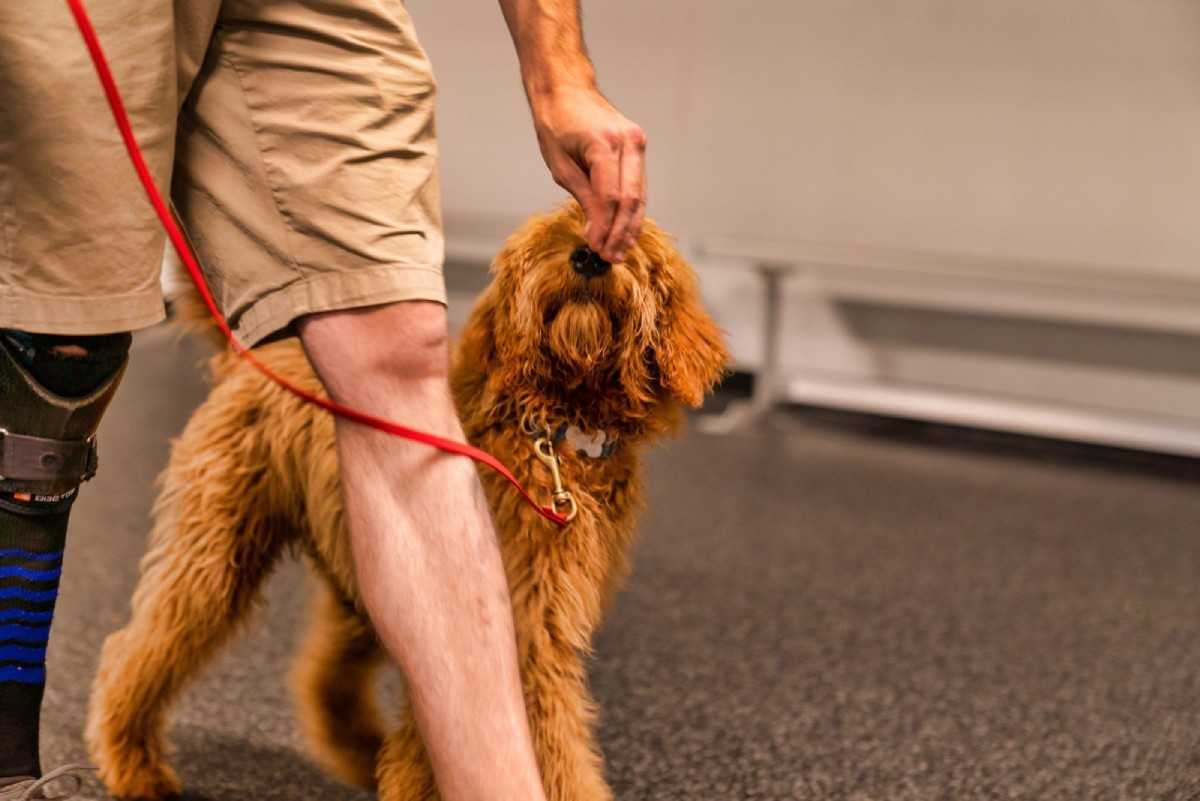
Goldendoodles are friendly, social and smart, which is why you see them on every block from Brookside to Overland Park. Those same traits are also why doodle owners so often end up asking for help. A dog that loves everyone, has energy to burn and learns fast will learn the wrong things just as quickly as the right ones.
One thing up front: we don’t train Goldendoodles differently than any other dog. Every dog at KC Dawgz goes through the same proven training process, whether it’s a doodle, a German Shepherd or a shelter mix. What changes from breed to breed is the list of problems owners run into. Below are the Goldendoodle behavior problems we see most, why doodles are prone to them, and when it’s time to get help.
Goldendoodle Problems at a Glance
| Problem | When It Usually Shows Up | Why Doodles Are Prone to It |
| Jumping and wild greetings | Puppyhood through about 2 years | Loves people, low impulse control |
| Mouthing and grabbing things | Puppyhood, peaks while teething | Two retriever parents |
| Pulling and “selective hearing” | Around 6 to 18 months | Adolescence plus high energy |
| Separation stress | Any age | Very people-focused |
| Fear of strangers, dogs or noises | Often noticed in the first year or two | Mixed genetics, varies by dog |
| Reactivity toward other dogs | Adolescence and up | Frustration and fear |
| Fussing about grooming and handling | Any age | A coat that needs constant care |
Where Goldendoodle Problems Come From
A Goldendoodle is a cross between a Golden Retriever and a Poodle. Both parents were bred to work closely with people. The Golden Retriever is a Scottish bird dog, and the Poodle started out as a German water retriever. That’s why doodles tend to be people-focused, mouthy and full of energy.
Doodles also vary more than most purebreds. An F1 doodle is half Golden and half Poodle, an F1B is about three-quarters Poodle, and multigenerational doodles are bred doodle to doodle. Some have Miniature Poodle parents. Two puppies from the same litter can grow into very different dogs, in coat and in temperament.
Breed is only part of the story for any dog. A large 2022 study in Science found that breed explains only about 9% of the behavior differences between individual dogs. Early life, socialization and daily routine matter a lot.
The Goldendoodle Behavior Problems We See Most
1. Jumping and Over-the-Top Greetings
This is one of the most common doodle complaints. Your doodle loves people so much that every guest, neighbor and toddler gets a full-body welcome. It knocks over kids, muddies clothes and scares people who aren’t dog lovers.
It’s an impulse control problem, not a personality flaw, and impulse control can be taught. Our post on how to stop your dog from jumping on people is a good place to start.
2. Mouthing, Chewing and Grabbing Things
With a retriever on both sides of the family tree, doodles love having something in their mouth. Puppies mouth hands, sleeves and pant legs, especially while teething, which usually wraps up by about 6 months. Older doodles often steal socks, shoes and remote controls, then run off to start a game of chase.

Puppy mouthing is normal, but it needs direction early. See our guide on how to stop a puppy from biting, and consider puppy training while the habits are still easy to shape.
3. Pulling on the Leash and “Selective Hearing”
Somewhere between about 6 and 18 months, many doodles hit a teenage phase. They drag you down the Trolley Track Trail, ignore you at the dog park and act like they’ve never heard the word “come.”
Research backs up what owners see. A study of young dogs found that at 8 months they were more likely to ignore a known cue from their own owner than they were at 5 months, and that it got better by 12 months. Your doodle didn’t forget everything. It’s a phase, and the habits you build during it stick. Our posts on leash pulling and recall cover the basics.
4. Separation Stress
Doodles bond hard. Many follow their people from room to room and struggle when left alone. Signs include barking or crying after you leave, chewing door frames, pacing and accidents.
A 2026 study from the Royal Veterinary College found that Labradoodles scored higher than Labrador Retrievers on separation-related behavior. Building calm alone time on purpose, starting with short absences, helps a lot. If your doodle panics when you leave, read our guide to separation anxiety training.
5. Fear of Strangers, Other Dogs or Noises
Not every doodle is a social butterfly. Some are nervous around new people, unsure of other dogs or rattled by thunder and traffic. A 2019 study comparing Goldendoodles with their parent breeds found that the doodles scored higher than Golden Retrievers on fear of strangers. The Royal Veterinary College study found Labradoodles scored higher than Labradors on fear of noises and new things.
These are owner surveys, so they don’t predict what any one dog will do. They do match something we see often: a “friendly breed” can still be a worried dog. Good socialization in the first months makes a real difference.
6. Reactivity Toward Other Dogs
A doodle lunging and barking at other dogs on a walk surprises a lot of owners. Sometimes it’s frustration: the dog wants to say hi and can’t. Sometimes it’s fear. Often it’s a mix of both.
The same 2019 study found Goldendoodles scored higher on aggression toward other dogs than Golden Retrievers or Poodles. It was a small sample, but it’s a good reminder that doodles aren’t automatically easy with other dogs. If walks have become stressful, see whether a trainer can help with leash reactivity, or learn about our reactive and aggressive dog training.
7. Fussing About Grooming and Handling
A doodle coat needs regular brushing, trimming and ear cleaning. A doodle that fights the brush, pulls its paws away or hides from the groomer gets brushed less, mats worse and often ends up shaved down.

Key Takeaway: Handling practice is training too. Short, positive sessions touching paws, ears and the coat help your doodle relax at home and at the groomer.
Rule Out Medical Causes First
A sudden change in behavior deserves a vet visit before training. Researchers estimate that pain plays a part in about a third of the behavior cases referred to specialists. For doodles, a few health issues are worth knowing about:
- Ear infections. Floppy, hairy ears trap moisture, and research on doodle health found Labradoodles had higher odds of ear infections than Labradors. A sore ear can make any dog grumpy about handling.
- Allergies and upset stomachs, which can make a dog itchy, restless and irritable.
- Thyroid levels, if your dog also has physical signs like weight gain or low energy. Golden Retrievers are prone to low thyroid, though it’s often overdiagnosed, so test rather than assume.
Goldendoodle Myths Worth Dropping
- “Doodles are hypoallergenic.” A study of dog allergens found no evidence that so-called hypoallergenic breeds, Labradoodles included, have lower allergen levels in the home.
- “Doodles don’t shed.” Coats vary a lot, especially in first-generation litters.
- “Doodles don’t need much training.” The Royal Veterinary College researchers specifically warned against the belief that designer crossbreeds require minimal training or are naturally suited to homes with kids.
When to Call a Trainer
- Jumping or mouthing that is hurting people or scaring guests.
- Lunging, barking or growling at other dogs or people.
- Panic, destruction or nonstop barking when left alone.
- A doodle that can’t be groomed or handled without a fight.
- Teenage behavior that is still getting worse after about a year old.
If any of these sound familiar, start with a free evaluation. We’ll meet your doodle, see what’s going on and recommend the right fit, whether that’s puppy training, day training, board & train or private lessons.
Common Questions About Goldendoodle Behavior
Are Goldendoodles Hard to Train?
No. Doodles are smart and eager to please, so they learn quickly. The hard part is their energy and excitement, which can drown out what they know. Consistent practice around real distractions is what makes training stick.
Do Goldendoodles Need a Different Kind of Training?
No. We use the same training process for every dog. What changes is what we focus on, because doodles tend to bring their own set of problems, like jumping and over-excitement.
Why Is My Goldendoodle So Hyper?
Two energetic retriever breeds went into your dog, and many doodles are bored more than they are bad. Daily exercise plus brain work, like the ideas in our post on whether dogs get bored, helps a lot.
At What Age Do Goldendoodles Calm Down?
Many settle noticeably once they’re through adolescence, often around 2 years old, though every dog is different. Good habits built during the teenage months make it much easier.
Get Help With Your Goldendoodle
Most doodle problems are predictable, and most are very fixable when you start early. Book a free evaluation and our team will help you build a plan for your dog.